History & origins
Nosara: A Century of History, a Present, and a Future that Challenges Us
E. Gutiérrez · August 26, 2025 · Updated August 29, 2025 · 3 min read
Nosara did not begin with tourism or the real estate projects of the 1970s. Long before that, this land was part of the Kingdom of Nicoya, a region that, at the time of the Spanish arrival (1521–1524), concentrated almost half of the entire Costa Rican population. The name “Nosara” is interpreted as alliance, a place for everyone, and that indigenous root reminds us that this has always been a space of encounter and mestizaje.
From then on, the traces become more concrete: in 1886, Nicolás Dchyore y Mayorga requested permission to extract rubber in the public lands of the Republic in Nosara; in 1916, the first documented Nosareño, Plutarco Castrillo Valencia, was born; and around 1935, a hectare of land cost only ₡50 colones. In 1974, the average schooling of the population barely reached second grade, and in 1988 the district was officially established, though under the name “Baltodano”, soon after recovering its identity as Nosara.
Today, after more than a century of transformations, Nosara presents itself as a community in constant tension between its history, its present, and its future. The Nosara Census 2024, the result of three years of community work and an unprecedented effort in Costa Rica, offers us a portrait that is both clear and challenging of who we are. We celebrate that this effort reached 95.1% coverage, and from now on, begins the stage of disseminating the data, analyzing it, and using it as a basis for positive change.
A community in growth
The Nosara Census 2024 reported 8,716 permanent residents distributed across 3,228 households (2.7 people per occupied home). But the floating population radically changes the picture: in December 2024 alone, Nosara hosted 26,650 temporary residents in short-term rentals. Added to this are 188 homes under construction, reflecting a growth model driven by migration (2,346 people moved to Nosara since 2011), while births from locally rooted families become fewer and fewer.
Health and lives at risk
Although Nosara is recognized as part of Costa Rica’s “Blue Zone,” the data raise alarms: men die more frequently and at younger ages, mostly from preventable causes such as motorcycle accidents, firearms, heart disease, and cancer. Most serious of all, 47% of all recent deaths occurred without receiving medical care. Seven out of ten people have health insurance, and over the past five years, more than 13,000 emergencies were reported, an average of seven per day, 60 km from the nearest hospital.
Education: progress, but at what pace?
In 1974, average schooling was only 2 years; by 2000, it had reached 5 years, and in 2024, just 8 years. In other words, we are advancing 3 years of schooling every 25 years, meaning it would take until 2050 to reach the goal of at least a high school completion on average.
We celebrate that today, mothers in Nosara reach an average of 11 years of schooling, and that teenage pregnancies are declining. Yet the pace remains insufficient to face the community’s challenges in the coming decades, where education is closely linked to job quality, rootedness, and quality of life.
Water and housing: a growing debt
Nosara has 3,322 water meters under ASADAs, a number that barely keeps pace with the growing number of homes. Meanwhile, construction advances rapidly: the district processed one million m² in projects valued at $300 million in just 5 years. However, in the last 10 years, only 2 out of every 1,000 projects have been public works. Public institutions lag far behind compared to the speed of private investment and construction, increasing the perception that services are saturated and insufficient relative to development.
The fading citizen voice
The electoral roll grows by 5% every year, yet abstentionism reached 74% in 2024. The paradox is clear: Nosara welcomes more people, grows faster, but participates less and less in the decisions that define its future. This is one of the main alarms.
What we must decide
The portrait offered by the Nosara Census is not just a mirror; it is a call. It reminds us that, to sustain this community, we must demand and build better healthcare and emergency services, more education, dignified housing, safe water, and real citizen participation.
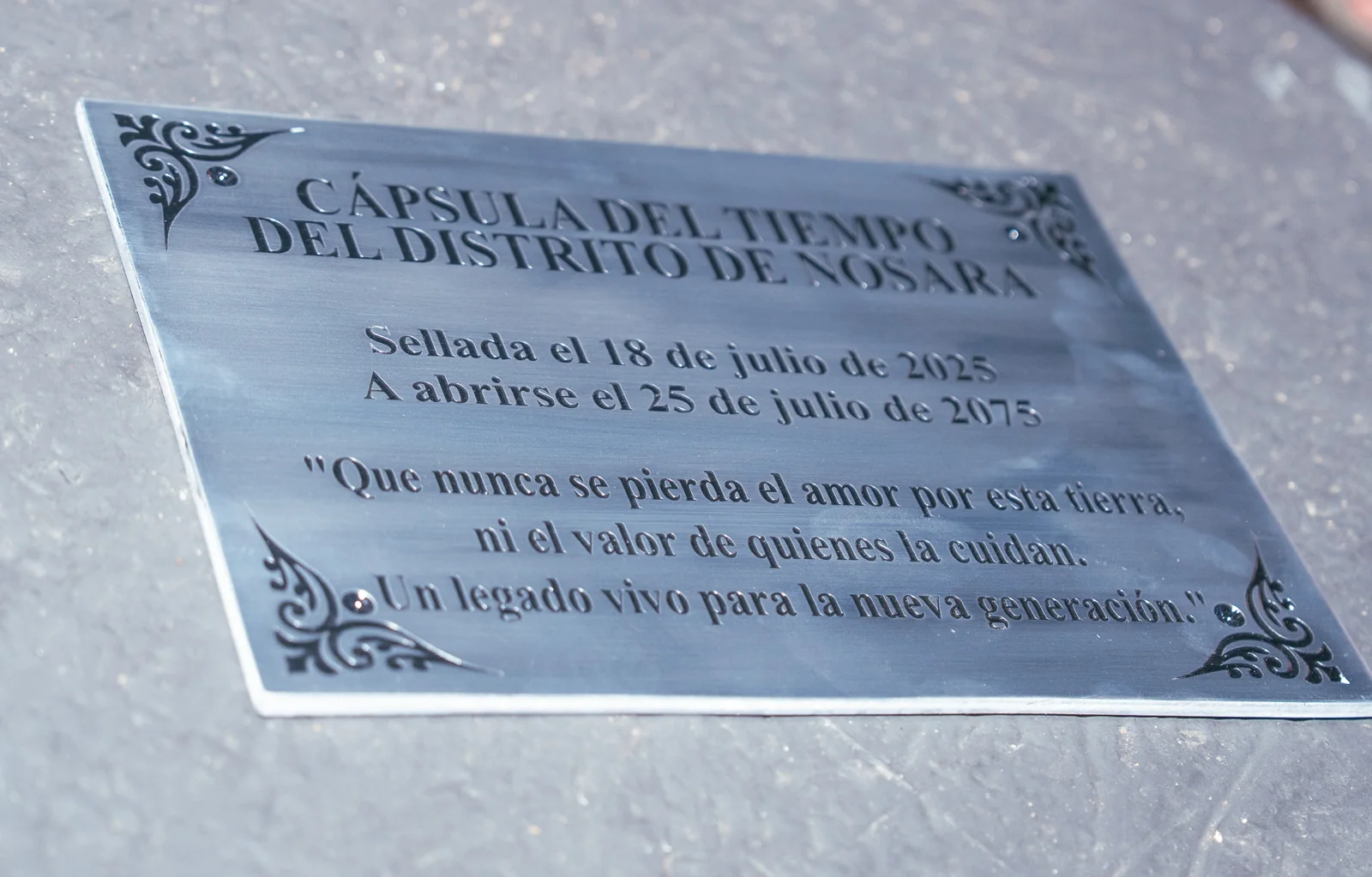
The past left us with names, roots, and memories. The present offers us data and challenges. The future will depend on what we decide today. We sealed this commitment on July 18, 2025, when we placed a time capsule to be opened in 2075. That capsule carried the message: “May the love for this land never be lost, nor the courage of those who care for it.”
Source: Nosara District Population and Housing Census 2024, ADC and ConoSer.